


You know something is bothering you. You may even have a very good idea where it comes from.
But when you try to explain it, the words do not quite reach it.
Maybe the issue feels too big and tangled to know where to begin. Maybe you have told the story so many times that you can hear yourself slipping into the same familiar explanation. Or perhaps the subject feels private, embarrassing, or simply too tender to put neatly into sentences.
You might find yourself saying:
“It’s always been there.”
“I know this sounds silly, but…”
“I understand it in my head. I just can’t seem to change how I feel.”
“I don’t want to go through every detail again.”
If that sounds familiar, it does not mean you are resistant, doing the work incorrectly, or failing to understand yourself. Sometimes words are simply not the easiest—or gentlest—way into an experience.
This is one reason I trained in Picture Tapping Technique, or PTT—and one reason I love using it. It combines EFT Tapping with simple drawings, shapes, colours, and imagery, giving us something concrete to work with when the issue feels big, messy, or hard to say aloud. You do not have to explain it perfectly or share more than you want to.
PTT is not about making art. It is not about me interpreting your drawings. And it is not a clever way to decide what your experience “really” means.
It is a gentle, client-led way of allowing your own experience to unfold through a guided sequence of pictures and tapping.
What Is Picture Tapping Technique?
Picture Tapping Technique is a specialised application of conventional EFT, developed by Philip Davis and Christine Sutton. Instead of beginning only with a spoken description of the issue, you make a simple drawing that represents whatever feels present for you.
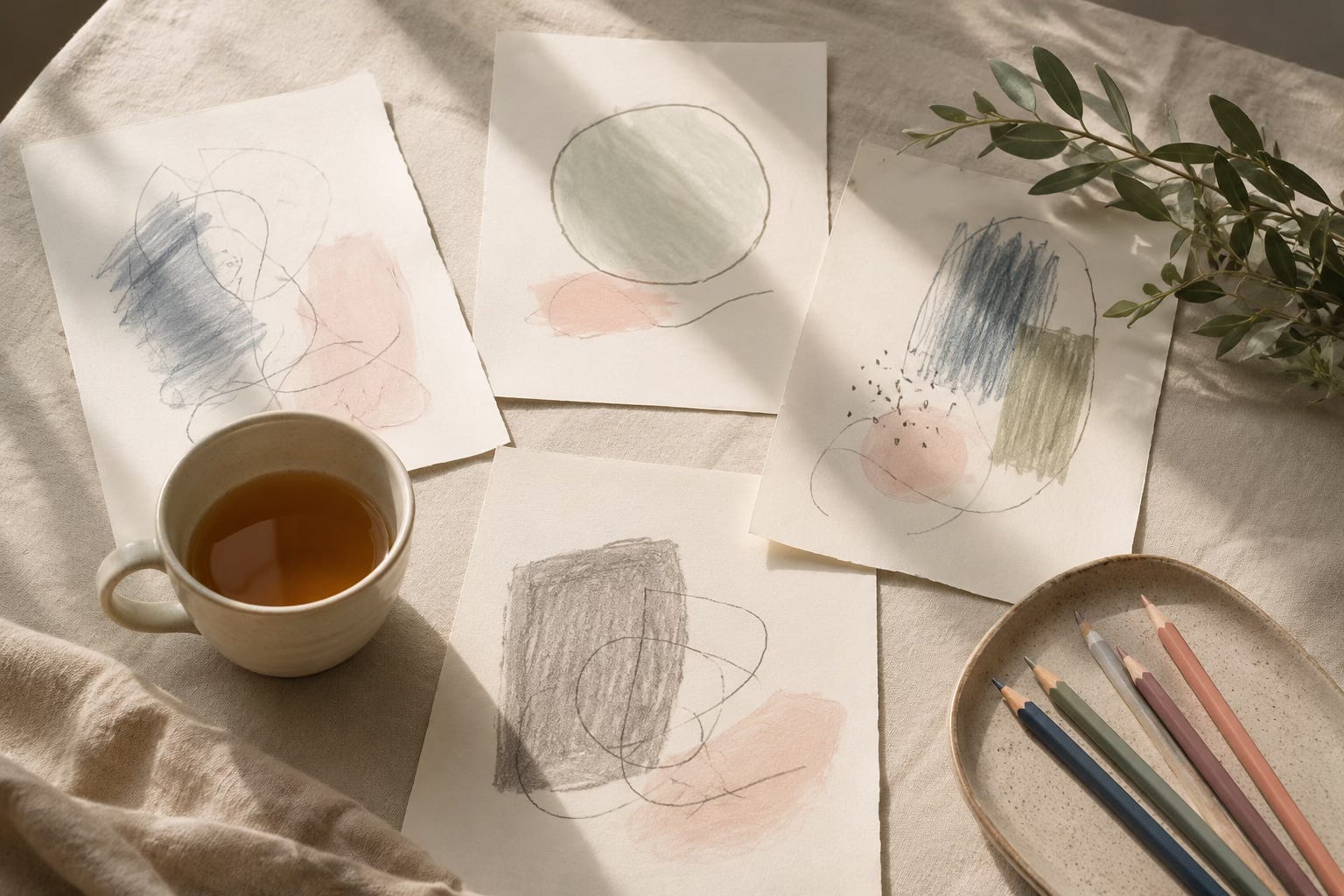
That drawing might contain stick figures, blocks of colour, arrows, shapes, a scribble, or a single dark line across the page. It may look like a scene, or it may not look like anything recognisable at all.
There is no artistic standard to meet. You cannot fail at this because your picture is not being judged, analysed, or displayed. Its only job is to give your experience a form that feels true enough in that moment.
We then use the factual elements of your picture as the focus for tapping. I follow the exact words and descriptions you give me. After tapping with that picture, you set it aside and make another picture of how the issue feels now.
Sometimes the second drawing looks similar to the first. Sometimes a colour, shape, or the entire picture changes. None of those possibilities is automatically “better,” and I do not decide what the change means.
The meaning—if there is one you want to name—belongs to you.
PTT is not an assessment, personality test, or form of dream interpretation. A picture does not have one correct meaning waiting for the practitioner to uncover.
My role is to guide the EFT process, hold a calm and compassionate space, keep the pace manageable, and stay attentive to what is happening for you. You lead the content, the imagery, the language, the insights, and how much you wish to share.
Why Pictures Can Help When You Feel Stuck in Words
Some experiences arrive as clear thoughts: *I am afraid she is disappointed in me.* Others do not.
They may arrive as pressure in your chest, a heavy grey feeling, a sense of being pulled in three directions, or the conviction that something is wrong even though you cannot explain what. You may hold several feelings at once—anger, grief, loyalty, guilt, love—and find that every sentence leaves something important out.
A picture can hold those contradictions without asking you to tidy them up first.
It can also create a little space around an experience. Instead of having to stay entirely inside the feeling while explaining it, you can place something on the page and work with what you see there. The issue has not been dismissed or minimised. It has simply been given a gentler form.
If you are usually good with words, PTT may sound like an unexpected choice. You may have journalled about the issue, discussed it in therapy, listened to the podcasts, and found language for every part of the pattern.
That insight matters. But I often meet women who can explain a pattern beautifully and still feel their stomach drop, chest tighten, or mind begin racing when it happens again.
A picture gives us a different doorway. It does not reveal a secret truth or give me special access to your subconscious. It simply lets your experience speak in another form—through colour, metaphor, sensation, or several feelings at once—without asking you to make it sound sensible first.
And because the picture comes from you, the process remains yours.

When I Might Offer Picture Tapping in a Private Session
I do not pull out PTT simply because drawing seems more interesting than talking. I may offer it when words seem to be making the issue tighter, more tangled, or harder to reach—and only if the client feels comfortable trying it. It is one specialised option within my wider Clinical EFT work, not something every client must do.
It may be helpful when an issue feels:
big, messy, or difficult to separate into one clear part
as though it has “always” existed or will “never” be different
embarrassing, shame-filled, or hard to say aloud
caught in a familiar narrative that keeps circling
present in the body but difficult to describe
emotionally charged enough that approaching it directly does not feel like the best first step
Sometimes I might ask, *“Would it feel easier to draw what this is like than to explain it?”*
That is an invitation, not a direction. You can say yes, no, or not today.
Most Clinical EFT work benefits from specificity. Rather than tapping broadly on “my anxiety,” “my boundaries,” or “my whole childhood,” we will often begin with one recent moment, one anticipated situation, or one part of an event that carries emotional charge.
Picture Tapping offers a useful variation. When the issue genuinely feels too broad or layered to divide into words, we can sometimes begin with the larger feeling—*all of this pressure*, *the part of me that never feels good enough*, or *this thing I do not want to explain*—and let the sequence of pictures bring forward the aspects that matter to you.
I am not choosing those aspects for you. I am not deciding which memory is the root, or steering you towards a childhood explanation. The pictures and your responses give us the focus, and we follow what is actually present.
This can be especially valuable when shame is involved. You may want support with an experience without giving me every detail. In PTT, it is possible to work with this dark shape, the space between these two figures, or all this red here using the language that feels safe and accurate to you.
You remain in control of what you disclose.
PTT can also be used gently with emotionally charged or trauma-related experiences. But gentle does not mean that difficult feelings can never arise. A picture may bring up more than you expected, just as a word, memory, or body sensation can. This is where my training matters: I pay attention to your pace, notice when we need to slow down, and do not push you further than feels workable.
Sometimes PTT is a good fit. Sometimes another gentle Clinical EFT approach is more appropriate. Sometimes the right support is a licensed mental health professional or another form of care. I do not assume one technique is right for every person or every issue.
What the Process Can Look Like
Although PTT uses a clear structure, a real session should not feel like I am moving you through a rigid set of instructions. The structure holds the process; your experience determines where it goes.
We begin with what you want support with
You do not need a perfect goal or a complete history. We slow down enough to understand what feels present, what you hope might feel different, and whether PTT feels like an appropriate way to begin.
I also pay attention to how you are feeling as we begin. If putting the issue on paper feels like too much, we do not force it. We can pause, approach it more gently, choose another EFT method, or leave the subject alone for that day.
You make the first picture
You draw whatever comes. There is no need to plan it or make it attractive.
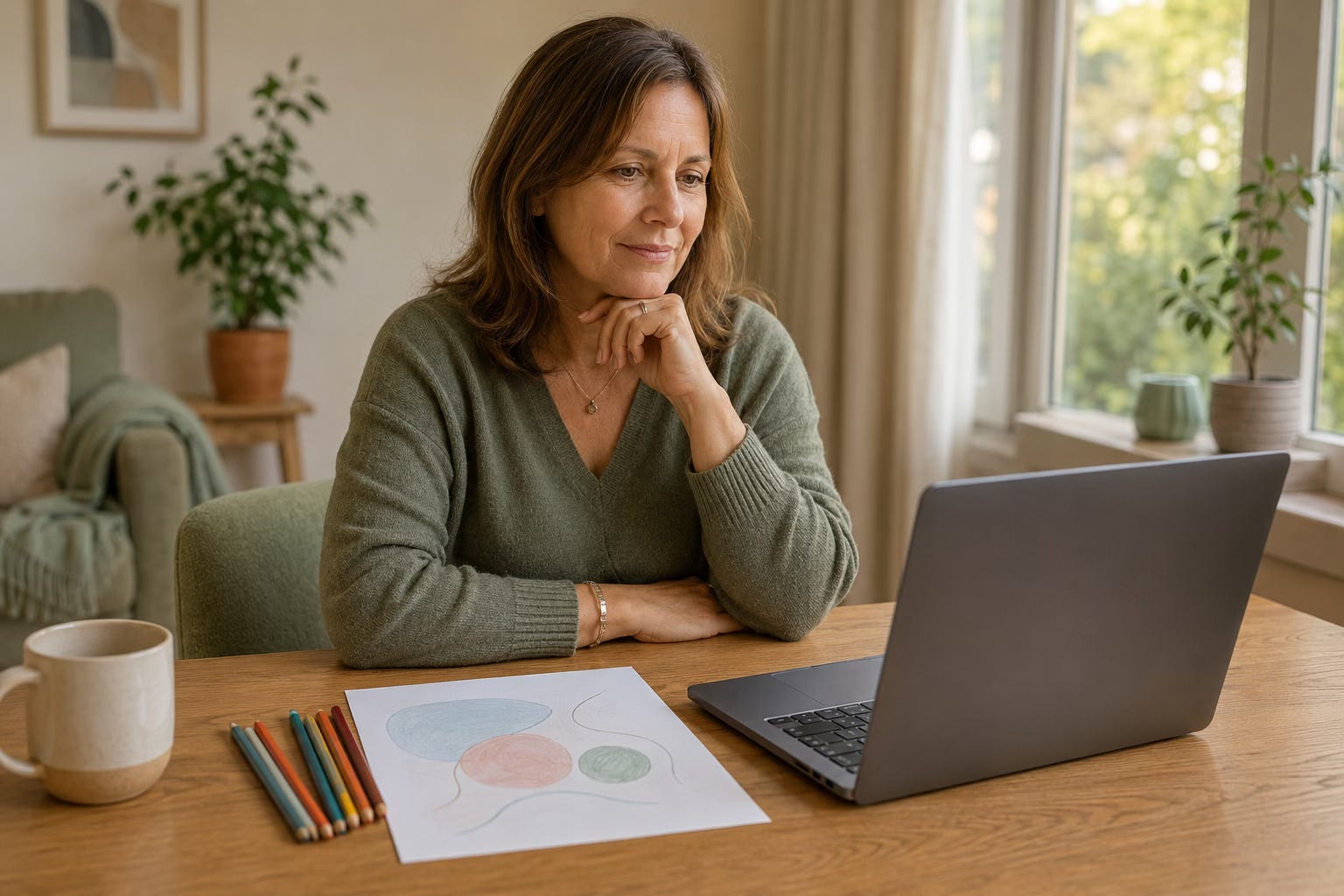
You might draw a tiny figure beneath a black cloud, fill the page with tangled lines, or use three coloured circles. You may not know what your picture means—and you do not have to.
I do not lean over the page and analyse it. I may ask what you have drawn, what colour or shape a particular part is, or what title you would give the picture. Your exact descriptions become our language for tapping.
Using only the words you have given me, we tap gently with the factual elements of the picture. That might sound as simple as this heavy shape, all these tangled lines, or this part that wants to disappear—if those are your words. The phrases do not need to sound elegant or positive. If you prefer not to explain the image, the picture itself can remain the focus.
My job is not to supply the insight. It is to help you stay connected to your experience without also having to manage the structure or work out what should happen next.
You draw what comes next
After tapping, we set the first picture aside and I invite you to draw how the issue feels now. The new picture may look completely different, change only slightly, or appear not to have changed at all.
I do not interpret those changes or decide what they mean. I keep my questions anchored to what you have actually drawn, use your own words, and guide the tapping from there.
We continue in this way—picture, tapping, new picture—until you recognise that a picture represents resolution. You are the one who knows whether the sequence has reached that point. I do not decide it for you or ask you to manufacture a cheerful ending.
Once you identify a resolution picture, I guide you through the final framing and colour process. We then review the full sequence together. If an earlier picture still brings an emotional response, that becomes the starting point for another sequence so that we can continue working towards resolution.
One of the things I love most about PTT is that I do not announce when you are “done.” You recognise the resolution for yourself. The change belongs to you.
If we do not have enough time to complete a sequence safely, I do not simply leave it emotionally open. I guide you through a containment process so that the unfinished material can feel safely held until we return to it.
Why Trained Guidance Matters in Picture Tapping
On the surface, PTT can look almost too simple: draw, tap, draw again. But that simplicity is held by a very specific process. We continue through the pictures until you recognise resolution, then complete the framing and colour work and review the sequence for anything that still carries an emotional response.
That is why I offer PTT as guided work. When you are already feeling something vulnerable, you should not also have to remember the protocol, decide what comes next, and monitor whether the sequence has been completed safely.
There is also value in having another person remain calm and non-judgmental when something vulnerable appears. You do not have to make the picture understandable to me, defend your reaction, or produce an inspiring insight.
The support is not valuable because I know what your picture means better than you do. It is valuable because I know how to guide the process without taking its meaning away from you.
Because I am trained in both Advanced Clinical EFT and Picture Tapping, I am not simply leading you through a drawing exercise. I am paying attention to how the sequence of pictures changes, the exact words you use to describe them, whether a block appears, and whether you recognise that the picture represents resolution.
I keep the process anchored to what you have drawn without interpreting it or steering it towards a conclusion. I also know when we need to slow down, safely contain unfinished work, or use another EFT approach because it would be a better fit.
You do not have to wonder whether you are following the process correctly, decide what should happen next, or manage the structure while you are already feeling something vulnerable. You get to stay with your experience while I hold the structure, pacing, and thread of the work.

What This Can Look Like in Real Life
One client, Jennifer, used Picture Tapping as part of our work with misophonia. We did not use it to convince her that the sounds should not bother her—or that her response was unreasonable. We worked with her experience as it was and followed what changed for her.
Afterward, she shared:
“If you are like me and suffer from misophonia, definitely consider EFT with Kay.
The Picture Tapping session gave me hope that I could actually enjoy coffee time with my sister. It actually worked, as she visited this past weekend. I did notice she slurped her coffee, but it didn’t make me want to leave the room.
I now feel calmer and am overall spending less time with my mind/thoughts preoccupied with my misophonia. I no longer have anxiety before meals.”
Jennifer Hall, St. Petersburg, FL
Her experience is not a promise that every person—or every issue—will change in the same way or at the same pace. What makes it meaningful is the everyday difference: the sound was still there, but it no longer had the same grip on her experience.
That is often the kind of change we are looking for. Not emotional numbness. Not pretending something is fine. Not Kay deciding what should or should not matter.
More room inside the moment. Less urgency. More choice. A response that feels less consuming, so you can hear yourself again.
What You May Notice as the Work Unfolds
So far, every Picture Tapping session I have facilitated has brought some form of relief or meaningful movement. I share that as my practitioner experience, not as a promise that every person will have the same result.
Sometimes the shift is an insight the client could not reach through words. Sometimes the emotional charge softens without a dramatic revelation. Sometimes she meets a part of herself with more compassion, or feels more peaceful towards another person or the situation itself—without being told to forgive, reconcile, stay, leave, or take any particular action.
What I love is that I have not talked her into that shift. It has emerged through her own pictures, in her own language, at her own pace.
These are possible signs of movement, not guaranteed outcomes. PTT is not a magic shortcut, and the value of a session cannot always be measured by how dramatic it feels.
Quiet change counts, too.
You Might Be Wondering…
“But I cannot draw.”
You do not need to. A stick figure, colour block, line, or scribble is enough. PTT is about expression, not artistic ability.
“Will I have to explain every picture?”
No. You choose what you want to say. We can use the words you give to the picture without requiring you to tell the complete story behind it.
“Will you interpret my drawings?”
No. I may ask what you have drawn, what colour or shape it is, or what title you would give the picture. I do not tell you what an image means. Any insight or meaning remains yours.
“What if something difficult comes up?”
We slow down. You can pause, stop, change focus, or choose another approach. I keep the pace responsive to you and do not push for a breakthrough. If what arises needs care outside my scope, I will say so and support you in considering an appropriate next step.
How Picture Tapping Fits Inside Inner Harmony
Picture Tapping is one of the specialised approaches I may draw on inside Inner Harmony. It is not a compulsory stage, a separate add-on, or a technique I decide you “need” before listening to you.
Inner Harmony is a private, personalised Clinical EFT program comprising nine 90-minute sessions over approximately three months—usually 12 weeks, with flexibility up to 14 weeks when needed.
We begin with a Deep Discovery Call as part of those nine sessions. This gives us spacious time to understand what you want support with, how the pattern is affecting your daily life, and what you would like to feel instead.
From there, I create a [personalised Healing Roadmap](https://blog.clinical-eft.com/p/healing-roadmap-clinical-eft)—a clear but flexible guide that gives our work direction without deciding in advance what your experience means or where it must lead.
Some sessions may use specific-event Clinical EFT. Some may focus on a present-day trigger, a feared future moment, a body sensation, or a belief that has become emotionally charged. Picture Tapping may be offered when imagery feels like a kinder or more useful doorway than talking alone.
The method follows the client—not the other way around.
That flexibility is part of what personalised support adds. You are not trying to fit every experience into the same tapping phrase or follow a generic recording when the emotional focus changes. I can stay with you as the work unfolds, keep the process grounded, and help you notice what feels workable today.
When You Do Not Have the Words, You Still Have Somewhere to Begin
If you have already talked, journalled, and thought about the issue from every angle, I am not going to ask you to arrive with an even better explanation.
You do not need to know which memory matters most or what a picture is supposed to reveal. You may not need more words at all.
A few lines, colours, or shapes can give us a place to begin. From there, I guide the picture-and-tapping sequence until you recognise resolution—without interpreting your drawings or deciding what that resolution should look like.
If you recognise yourself in this and want support that can meet you beyond the words you have already tried, you can read more about the Inner Harmony Program here:
With deep care,
🌿 Kay
EFT International Accredited Certified Advanced EFT Practitioner
Certified Picture Tapping Technique Practitioner
Mind-body coach offering gentle, trauma-informed support for anxiety, overwhelm, and nervous system regulation.
A note of care
This article is educational and is not a substitute for medical or mental health care. If what you are experiencing feels severe, overwhelming, or unsafe, please seek support from a qualified healthcare or mental health professional.