


Updated August 5, 2026 to include newer systematic reviews and meta-analyses.

If you have ever looked into EFT Tapping and thought,
“How can tapping on points on your face possibly help with anxiety or overthinking?” — that is a completely reasonable reaction.
Because I work with Clinical EFT in my private practice with thoughtful, self-aware women who are struggling with anxiety, overthinking, self-doubt, inner pressure, and reactions that seem to keep coming back no matter how much they understand themselves — this question comes up often. Sometimes it is asked directly, before someone decides to work with me. Sometimes it comes after a session, when a shift has happened and the person is a little surprised by it.
It sounds something like this:
“Does EFT Tapping actually work?”
“Is this evidence-based?”
“Is EFT a bit… out there?”
“Will this really help if I’ve already tried therapy, journaling, mindset work, or breathing exercises?”
Maybe you have wondered something similar.
I think that kind of critical thinking is worth honouring. If you are considering investing your time, money, and emotional energy in an unfamiliar method, you deserve a clear answer—not a sales pitch or an appeal to enthusiasm.
You may want to know:
Is this genuinely researched?
What does the evidence actually show?
And why might tapping help when understanding the pattern has not changed the reaction?
In this post, I want to answer that question directly. We will look at what Clinical EFT actually is, what the research suggests, and why the way EFT is practised matters enormously — especially when you are working with deeper emotional patterns that have not shifted through insight, journaling, or mindset work alone.
Let’s look at this clearly and honestly.
So—Is EFT Actually Evidence-Based?
Yes.
Clinical EFT has a peer-reviewed evidence base that includes randomised controlled trials, systematic reviews, and meta-analyses across anxiety, psychological stress, PTSD symptoms, depression, pain, cravings, and physiological measures of stress.
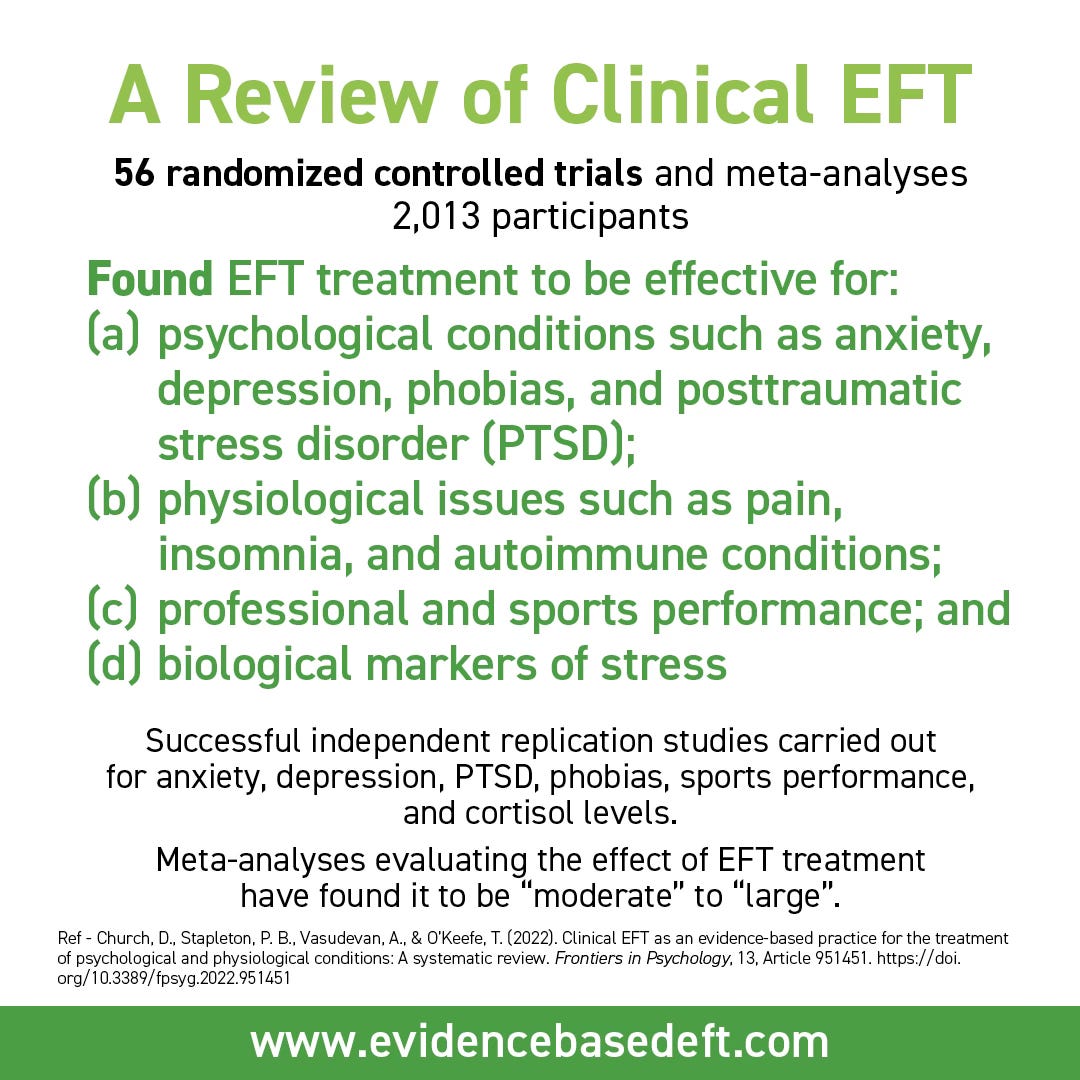
A 2022 systematic review identified 56 randomised controlled trials and eight meta-analyses of Clinical EFT. The review reported moderate-to-large effects across several psychological and physiological concerns and noted that improvements in a number of studies remained measurable at follow-up.
The 2022 review is one carefully defined part of a wider research picture. A 2025 overview of the broader Energy Psychology literature reports more than 300 peer-reviewed papers, including more than 100 randomised trials and 95 pre-post clinical outcome studies. Not every study carries the same evidentiary weight—but this is no longer a field resting on a handful of isolated papers.
More recent independent reviews add useful detail.
A 2025 systematic review of EFT for anxiety included seven randomised controlled trials with 506 participants. All six studies comparing EFT with no intervention reported greater reductions in anxiety in the EFT groups. In the smaller number of active comparisons, EFT produced outcomes similar to or better than breathing and progressive muscle relaxation, with no significant difference from CBT.
The reviewers described EFT as a promising and apparently safe complementary approach while also noting limitations in study size, consistency, blinding, and risk of bias.
A 2025 meta-analysis examining EFT for PTSD included 13 studies with 621 participants. EFT produced significantly greater reductions in PTSD symptoms than control conditions, and improvements in PTSD symptoms, anxiety, and depression were maintained for up to three months.
An earlier meta-analysis of EFT for PTSD also offers useful context about time. It found EFT effective across treatment protocols ranging from four to ten sessions.
That does not mean every person should be “finished” by session ten, or that layered trauma should ever be hurried. It does show that meaningful change has been studied within a focused period of support.
Research has also examined biological measures of stress.
In a 2020 randomised replication study, the EFT group experienced a 43.24% reduction in salivary cortisol after a one-hour session. That reduction was significantly greater than in the psychoeducation group, although the difference between EFT and the no-treatment group did not reach statistical significance.
A 2026 network meta-analysis of 17 randomised trials found that Clinical EFT was associated with a large reduction in psychological stress and a small-to-moderate reduction in physiological stress compared with controls. Most included studies raised some concerns or had a high risk of bias, so the authors called for further high-quality trials using both self-reported and biological measures.
So what does that mean in everyday language?
It does not mean EFT works for every person, every condition, or every situation.
It does mean Clinical EFT has moved well beyond being an untested wellness idea.
Taken together, the evidence supports Clinical EFT as a researched mind-body approach with promising psychological outcomes and some evidence of physiological change. It also leaves important questions about study quality, independent replication, longer-term outcomes, and how EFT compares with established treatments.
Some studies have also followed participants beyond the immediate session. The PTSD improvements above were maintained for up to three months. A chronic-pain trial reported benefits in pain and quality of life at six months, while selected food-craving and psychological improvements remained at two years, although weight and BMI changes did not.
These findings do not promise permanence. They do show that EFT research is measuring more than short-lived relief during a tapping session.
There are still important questions to study, including which clients benefit most, how EFT compares with established treatments across different conditions, and which mechanisms contribute most strongly to change.
But the responsible conclusion is not:
“There is no evidence.”
It is:
Clinical EFT has a meaningful and expanding evidence base, alongside genuine areas where more rigorous and independent research would strengthen what we know.
Simple does not mean superficial.
Accessible does not mean shallow.
And body-based does not mean unscientific.
What Convinced Me Personally
Before Clinical EFT became central to my work, I attended a seminar with clinical and health psychologist Dr Peta Stapleton.
She did not simply put a collection of studies on the screen. She made the research come alive.
She explained how the amygdala can sound the alarm when something feels threatening, how the hippocampus helps the brain place experiences in time and context, and how stress can affect us both emotionally and physically. She also shared what EFT research was beginning to suggest about cortisol, brain activity, and the way the body may respond during tapping.
I was fascinated. Actually, I was more than fascinated—I wanted in.
My first thought was not, I should build a practice around this.
It was, I want to learn this for myself.
I had my own emotional baggage—don’t we all? I knew what it was like to understand something in my mind and still feel it living in my body. If this gentle tool might support me emotionally and physically, why wouldn’t I want to learn it?
What began as something deeply personal eventually became professional. I trained, practised, studied, and kept learning until Clinical EFT became central to the way I support clients.
That is why the evidence still matters so much to me. I am genuinely excited by what the research shows—and I care about using it honestly. That means respecting the limits of the evidence, staying within my scope, continuing my training, and never losing sight of the person sitting in front of me.
To me, evidence-informed practice is not about dropping study names into an article. It is about bringing research, practitioner skill, ethical care, and a real human being into the same room.
Why EFT Looks Strange at First
If you are used to solving problems through thinking, analysing, researching, or understanding, EFT can feel unfamiliar.
I completely understand that reaction.
Tapping on points on your face and upper body can look unusual at first.
In my practice, I see this in almost every session: emotional intensity can begin to change surprisingly quickly—sometimes within minutes.
That does not mean every issue is resolved in minutes, or that every session unfolds in the same way. It means that even when the larger pattern needs time and care, something may begin to feel different—a tightness softens, a thought loses some of its grip, or the moment becomes easier to look at without being pulled straight back inside it.
Clients are often surprised that they can still remember what happened and think about it clearly, but the body sensation, emotional intensity, or sense of urgency is no longer quite the same.
That is usually the moment EFT stops feeling like such a strange idea.
Many thoughtful, capable women are very self-aware. They have read the books, done the therapy, understand where their anxiety or people-pleasing or inner critic comes from. They can explain their patterns clearly and intelligently. And yet — they still feel tense in certain moments, still react in the same old ways, still carry a level of inner pressure that does not seem to respond to understanding alone.
That gap is not a personal failure. It is often because emotional reactions are not only cognitive. Anxiety is not just a thought. People-pleasing is not just a mindset. Self-doubt is not just a lack of confidence. These responses often live in the body as well — as physical sensations, automatic reactions, and patterns that activate before thinking has had a chance to catch up.
You may feel your chest tighten before you have even opened the email. Your stomach may drop when someone gives brief, ambiguous feedback, before you have had a chance to reason about what it probably means. You may find yourself saying yes before you have checked whether you want to, or lying awake replaying a conversation you have already decided went fine.
These reactions can involve the body as well as thought. That may help explain why insight, journaling, and mindset work—even when genuinely helpful—do not always change how a familiar moment feels.
EFT invites the body into the process. For many women, that is the missing piece.

What Clinical EFT Actually Does
Clinical EFT is a manualised mind-body method that combines focused cognitive and exposure elements with tapping on acupressure points on the face, hands, and upper body.
Although it may look simple from the outside, the process is doing several things at once.
It brings attention to a specific emotional experience. It keeps the body involved in the process while that experience is present. It gradually reduces the emotional intensity of the issue in a way that feels manageable. And it creates more space between the trigger and the automatic response — which is where real choice begins to return.
Critically, it is not about pretending everything is fine, forcing yourself to think positively, bypassing your feelings, or trying to “tap away” difficult emotions. It is not about following a generic script and hoping it fits.
Clinical EFT is much more specific than that.
A session often begins not with a broad theme like “I want to feel less anxious” but with something specific and present: a recent moment that is still carrying emotional charge. Maybe it is the message you received this morning that made your stomach drop. Maybe it is the way your body tensed before an important conversation. Maybe it is the inner critic that gets loud when you imagine being more visible. Maybe it is the guilt that shows up the moment you try to rest.
Reflective questions help find the right doorway into the work: Where do I feel this in my body? What am I most afraid would happen? What does this remind me of? But those questions are the doorway, not the work itself.
A central part of the process is tapping while gently holding attention on the specific trigger, belief, fear, or body sensation.
Rather than only talking about the issue or analysing it from a distance, we stay connected to the felt experience as it is present—emotionally, physically, and cognitively—while using the tapping process to help reduce its charge.
As we tap, what is on the surface may begin to soften, and something underneath may become clearer.
To give a simple illustration, a session might begin with:
My stomach drops when I see a message from my manager.
I would not assume there must be a childhood root or decide in advance what the reaction means. We stay with that specific moment and follow what you actually notice. Sometimes an earlier memory comes to mind; sometimes the useful work remains with the present-day event.
As the emotional charge settles, you may still remember the message and assess it clearly, but it can feel less like a verdict. The practical difference is more room to decide what the situation means and how she wants to respond.
This is also why the way EFT is practised matters. In my work, trauma-informed pacing means we do not force disclosure or push for a breakthrough. We work collaboratively, slow down when needed, and stay with what feels manageable.
Why Clinical EFT Is More Than a Tap-Along Script
This part matters. General tapping videos can be genuinely useful for learning the tapping points, calming everyday stress, or interrupting a spiral.
Personalised work becomes especially valuable when a pattern feels layered or keeps returning. Clinical EFT works best with specificity: not “this anxiety” in general, but one moment, one feared outcome, one body sensation, or the exact words carrying the charge. That can be difficult for any of us to hold alone when we are also inside the feeling.
Why EFT Can Feel Different With a Practitioner
Self-tapping can be genuinely helpful for day-to-day stress and moments that feel manageable. But when the issue feels layered, shame-filled, or incredibly familiar, it can be hard to be both the person feeling it and the person holding the entire process.
You may slip into analysing, reach for words that sound right but do not quite touch the feeling, or stop just as the emotional focus begins to change. None of that means you are doing EFT wrong. It means you are human—and sometimes it helps not to do both jobs alone.
My role is not to tell you what your reaction means or lead you towards a particular conclusion. I hold the structure so you can remain connected to your experience. I help us begin with one specific, manageable moment, guide the tapping, follow your exact words, and ask what you notice as the intensity changes.
There is also something powerful about being met by someone who is calm, present, and not frightened by what you feel. You do not have to tidy the emotion up, explain it perfectly, or keep track of every step while you are inside it.
And because I work in a trauma-informed way, faster is not automatically better. We do not hunt for trauma, push through overwhelm, or treat a dramatic breakthrough as the goal. You can slow down, change the words, tap silently, pause, or choose not to follow something that arises. If an earlier memory becomes relevant, you remain the one who decides whether we work with it.
That is what personalised support can add: not better “magic words,” but compassionate presence, specificity, pacing, and a process that can respond to you in real time.
Inside the Inner Harmony Private Program, this begins with a personalised Healing Roadmap. Together, we notice the triggers, body responses, beliefs, and everyday moments that feel most relevant to you. The roadmap gives us direction without deciding in advance what your experience means or where the work must lead. We begin with one manageable moment and adjust the pace according to what you notice.
One client who began with similar doubts described his experience this way:
“I’ll be honest—I didn’t think EFT was for guys like me. But the approach Kay uses is science-backed and practical. No drama, no reliving the worst moments—just a clear method that actually worked.
The physical tension I’d been carrying for months started to lift. I could think clearly again—make decisions without the constant fog of anxiety.”
—S.P., Entrepreneur
A Few Questions You Might Have
“Will I feel better right away?”
Sometimes. A thought may feel lighter, a body sensation may soften, or a little more space may appear after one round. That is encouraging, but it is not the same as resolving a long-standing pattern. Deeper work usually builds across a series of carefully paced sessions.
“Can I use EFT on my own?”
Yes. Self-tapping can be supportive for everyday stress and situations that feel manageable. When the issue feels intense, old, or easy to become overwhelmed by, a trained practitioner can offer personalisation, pacing, and compassionate support. You do not have to navigate the harder material alone.
“Is EFT a replacement for therapy or medical care?”
No. Clinical EFT can be a valuable support, but it is not a replacement for medical care, psychiatric care, or mental health treatment when those are needed. It can often work alongside other forms of support well. Many of the women I work with come to EFT after years of therapy or other personal development work, not because those approaches failed, but because they want support that includes the body in the process — and that can reach the patterns that understanding alone has not fully shifted.
Research Cited
The following are some of the primary peer-reviewed papers discussed in this article. This is not an exhaustive list of Clinical EFT research.
Church, D., Stapleton, P., Vasudevan, A., & O’Keefe, T. (2022). Clinical EFT as an Evidence-Based Practice for the Treatment of Psychological and Physiological Conditions: A Systematic Review. Frontiers in Psychology, 13, 951451.
A systematic review identifying 56 randomised controlled trials and eight meta-analyses of Clinical EFT. The authors disclosed that Church and Stapleton receive income from publications and presentations related to EFT.Choi, S. H., Sung, S.-H., & Lee, G. (2025). Emotional Freedom Techniques for Anxiety Disorders: A Systematic Review. Healthcare, 13(17), 2180.
A review of seven randomised controlled trials involving 506 participants, including comparisons with no treatment, CBT, breathing therapy, and progressive muscle relaxation.Chen, W.-T., et al. (2025). Effectiveness of Emotional Freedom Techniques in Alleviating Symptoms Associated With Posttraumatic Stress Disorder: A Systematic Review and Meta-Analysis. European Archives of Psychiatry and Clinical Neuroscience, 275(7), 2027–2037.
A meta-analysis of 13 studies involving 621 participants, with improvements in PTSD symptoms, anxiety, and depression maintained for up to three months.Stapleton, P., Crighton, G., Sabot, D., & O’Neill, H. M. (2020). Reexamining the Effect of Emotional Freedom Techniques on Stress Biochemistry: A Randomized Controlled Trial. Psychological Trauma: Theory, Research, Practice, and Policy, 12(8), 869–877.
A randomised replication study examining cortisol and psychological distress following a one-hour EFT session.Stapleton, P., & van Elst, A. (2026). Clinical Emotional Freedom Techniques for Psychological and Physiological Stress Reduction: A Systematic Review and Network Meta-Analysis. Explore, 22(5), 103474.
A review of 17 randomised trials finding large reductions in psychological stress and smaller but significant improvements in physiological stress compared with controls. The first author disclosed possible remuneration from Clinical EFT-related keynotes, conference presentations and book royalties.Stapleton, P., Wilson, C., Uechtritz, N., Stewart, M., McCosker, M., O’Keefe, T., & Blanchard, M. (2025). A randomized clinical trial of emotional freedom techniques for chronic pain: Live versus self-paced delivery with 6-month follow-up. European Journal of Pain, 29(3), e4740.
A randomised clinical trial in which reductions in pain severity and interference and improvements in quality of life were sustained at six-month follow-up.
Stapleton, P., Lilley-Hale, E., Mackintosh, G., & Sparenburg, E. (2020). Online Delivery of Emotional Freedom Techniques for Food Cravings and Weight Management: 2-Year Follow-Up. Journal of Alternative and Complementary Medicine, 26(2), 98–106.
A two-year follow-up reporting sustained improvements in selected food-craving and psychological outcomes, while finding that weight and BMI changes seen at 12 months were not significant at two years.

If You Have Been Quietly Wondering Whether EFT Could Help
If you have been sceptical — or cautiously curious — I hope this has offered a clearer picture of what Clinical EFT actually is and what the research genuinely supports.
It is not a wellness trend. It is not a magic wand. And it is not asking you to bypass your critical thinking or believe something just because it sounds hopeful.
It is a researched, body-based approach that can help you work with the emotional charge underneath reactions that understanding alone has not been able to fully shift. The anxiety that arrives before you have had a chance to reason your way through it. The guilt that floods in the moment you try to rest. The self-doubt that shows up even when everything is going well. The inner pressure that does not seem to respond to knowing better.
If that resonates, and especially if you are someone who understands your patterns but still feels caught in them, the Inner Harmony Private Program may be a meaningful next step.
It is designed for women who are tired of managing anxiety, overthinking, self-doubt, and inner pressure from the surface and are ready to work with the emotional and nervous-system patterns underneath them.
Across nine private 90-minute sessions over approximately 12–14 weeks, we use your Healing Roadmap to work with the patterns keeping anxiety, overthinking, self-doubt or inner pressure in place, with the aim of helping you respond with greater calm and steadiness.
If you are unsure whether this is the right level of support, you are welcome to book a private 15-minute consultation.
With deep care,
🌿 Kay

EFT International Accredited Certified Advanced EFT Practitioner
Mind-body coach offering gentle, trauma-informed support for anxiety, overwhelm, and nervous system regulation.
A note of care
This article is educational and is not a substitute for medical or mental health care. If what you are experiencing feels severe, overwhelming, or unsafe, please seek support from a qualified healthcare or mental health professional.